
Your Product Is Brilliant. Nobody Knows What It Does.
Here's Why That's a Marketing Problem, Not a Sales Problem.
Your product is unique and solves a real buyer need. But if buyers don’t understand it in 30 seconds, it’s usually because you’re not speaking their language.
I’ve been there. A blue light filtering tech company I worked with had the best technology in the industry and patents to back it up. But when R&D and sales got on the phone with customers, they focused on the science and technical data that backed it’s performance - spectra charts, wavelengths, etc.
It makes sense. When your company is heavily weighted toward R&D, employees live and breath that language. However, when you explain it the same way to a buyer, say in the enterprise space, they won’t care unless it’s crystal clear what’s in it for them.
When Your Team Speaks R&D and Your Buyers Speak ROI, Something Gets Lost
R&D-heavy companies (biotech, SAAS, data science, AI, deep tech, anything built on proprietary algorithms or science) have a specific problem. The thing that makes the product genuinely better is also the hardest thing to explain to a potential customer.

Your team knows the model works and have the data. But if you walk into a room with the decision maker and lead with that, and you'll watch their eyes glaze over. Soon, they’ll be checking emails on their phone.
It's not that buyers are unsophisticated. They're just asking a different question. Not "how does it work?" They want to know "what changes for my business if I buy this?" Those aren't the same conversation, and most technical companies are only set up to have one of them.
The competitor with weaker technology and a cleaner pitch will win if they use the right language tailored to the customer need.
At the blue light company I mentioned before, the pitch was focused on the specific wavelengths that were filtered, industry requirements and color performance. I rewrote the value proposition to focus on why the buyer should care. For enterprise, this meant increases in employee productivity and wellbeing. For education, it was protecting students’ eyes and helping them sleep better to improve academic performance. Same product. Same science. Completely different conversation.
The Problem Rarely Gets Diagnosed Correctly
Here's where it gets expensive. A positioning problem almost never looks like a positioning problem from the inside.
Marketing says leads aren't converting. Sales says the leads aren't qualified. The founder says no one's explaining the product right. Everyone's frustrated and nobody's wrong. But no one's finding the actual root cause either.
The real issue is one level up: buyers still can't quickly understand what you do, why it matters to them, or why you're better than whatever they're doing now.
Here's what that actually looks like day-to-day:
Sales cycles that drag on. When a buyer can't explain your product to the next person in the approval chain, the deal stalls. You can have the best salespeople in the world and they can't close what buyers can't re-pitch internally.
The founder has to be on every important call. If deals need you in the room to close, you've become the translation layer. That's a signal, not a compliment.
Good demos that go nowhere. People take the call, they're engaged, they say "this is really interesting" and then silence. They were curious. They just couldn't connect what you do to the problem they need to solve.
None of this screams "positioning problem." It looks like a sales problem, a pipeline problem, a hiring problem.
Why This Is So Common at $1M–$15M

Most technical founders at this stage have done the hard part. Building a product, networking for leads, and even bringing in real customers and revenue. This is usually built on founder relationships, referrals, and outreach that worked because you were behind it, but it can’t scale.
What got you here was your ability to explain the vision personally. What gets you to the next stage is a solid value proposition, where people who aren't you can make the case clearly and confidently, without you in the room.
That requires marketing work. Not a new tagline, not a website refresh, but real work on who you're for, what problem you solve better than anyone else, and what the outcome is for your specific buyer.
I’m not innocent. When I started my business, I sounded like everyone else. I focused on my experience and a list of marketing services I could provide under the “Fractional CMO” title. I changed my niche 57 times, updated my website every week, changed my business name, etc. But what was missing was my unique value, and more importantly, what it meant for founders. Increased productivity, competitive advantage, and overcoming “pain points”, like regulatory compliance or declining/ stalled revenue.
Why Hiring a Full-Time CMO Isn't Always the Answer
The instinct is to hire a VP of Marketing or a CMO and hand them the problem. Sometimes that's the right call, but when you have a limited runway and investors breathing down your neck, its not.
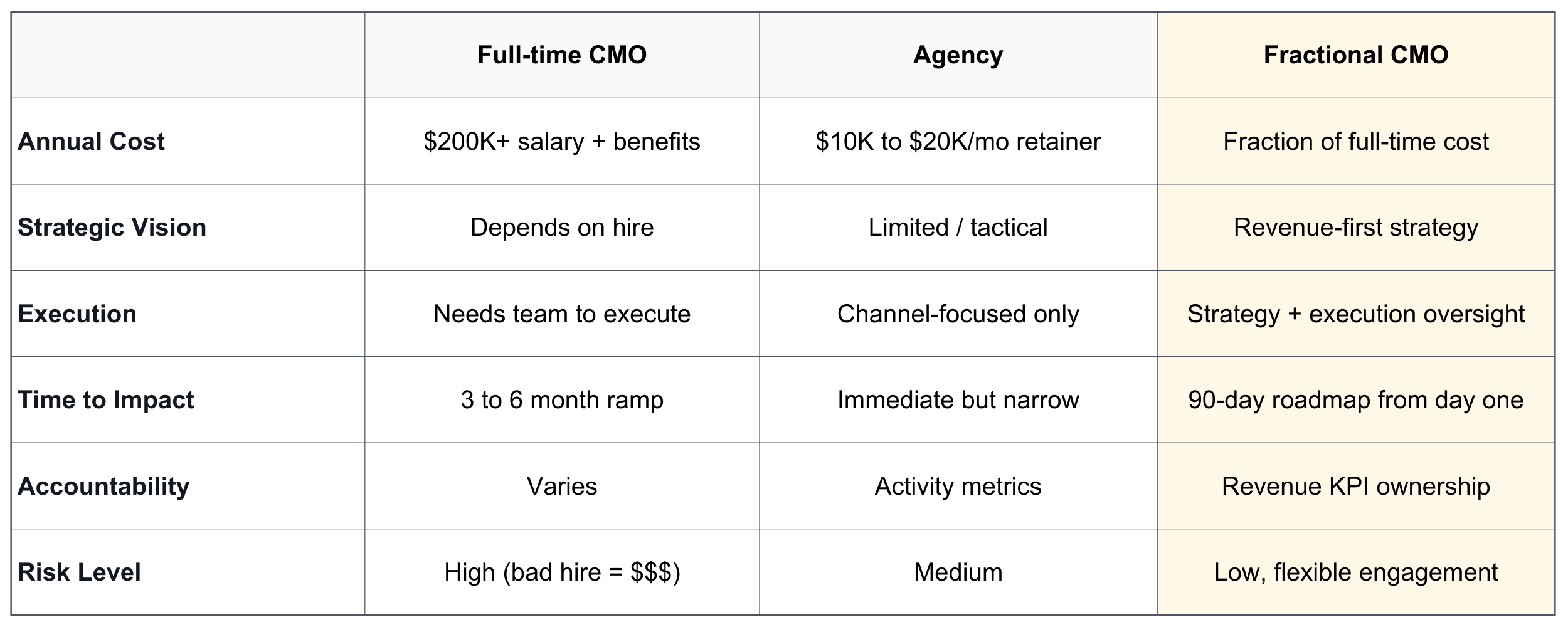
A full-time CMO is $200K or more, plus equity. Most of them are built to scale something that's already figured out, not to do foundational marketing work first. You'll spend six months and real money before you know if the foundation is right. And if the positioning is wrong, everything they build on top of it is wrong too.
A fractional CMO is a different thing. You get someone senior, with experience across multiple companies and product categories, focused on the work that actually needs to happen right now. No ramp time. No internal politics. No equity negotiation. Someone who can look at your business clearly because they're not inside it.
For a technical company, that work usually looks like this:
Getting specific about who you're actually selling to. Not "mid-market B2B." The exact buyer, their exact pain, the exact moment they go looking for a solution like yours.
Translating your technical edge into something buyers can feel. Sitting with your team, understanding what actually makes you better, and then saying: here's what that means for the person buying it.
Building messaging that travels without you. Your AEs can close deals. A prospect can forward your one-pager to their boss and it makes sense without a 20-minute explainer call.
Finding exactly where in the funnel the story breaks down. It's almost always one specific handoff (demo to proposal, outreach to response) where it falls apart. Most of the time it's fixable once you find it.
Getting product, sales, and marketing aligned on the same story. At this stage they're usually telling three different ones. That's confusing to buyers.
The fractional engagement flexes around what you actually need. Some companies need focused work for a few months and then they're set. Others want an ongoing partner. Either way, it's not a permanent headcount decision you're locked into.
What It Costs to Wait
Every quarter you run with unclear positioning is a quarter where good-fit buyers disqualify you before you ever get a shot, your sales team reinvents the pitch on every call, and a competitor with a weaker product wins because their story is cleaner.
The companies that fix this early don't just close faster; they build something that runs without the founder in every critical conversation.
It's Fixable
If this resonates even a little bit, it's not a product problem. It's a common challenge that comes with selling a technical, R&D-backed product.
I help complex technology companies explain what their product actually does and why it matters to buyers. If you want to figure out where your message is breaking down, I’d love to hear about it.
Elishaa Batdorf is a seasoned Fractional CMO who helps B2B startups and small businesses scale by providing leadership, strategy and execution. With 20 years of experience, she builds scalable, AI-enabled marketing operations to drive revenue and profit.
